Yemen Truce Collapse Risks Threaten Global Energy and Red Sea Shipping
Escalation Signals Point to Renewed Regional Conflict
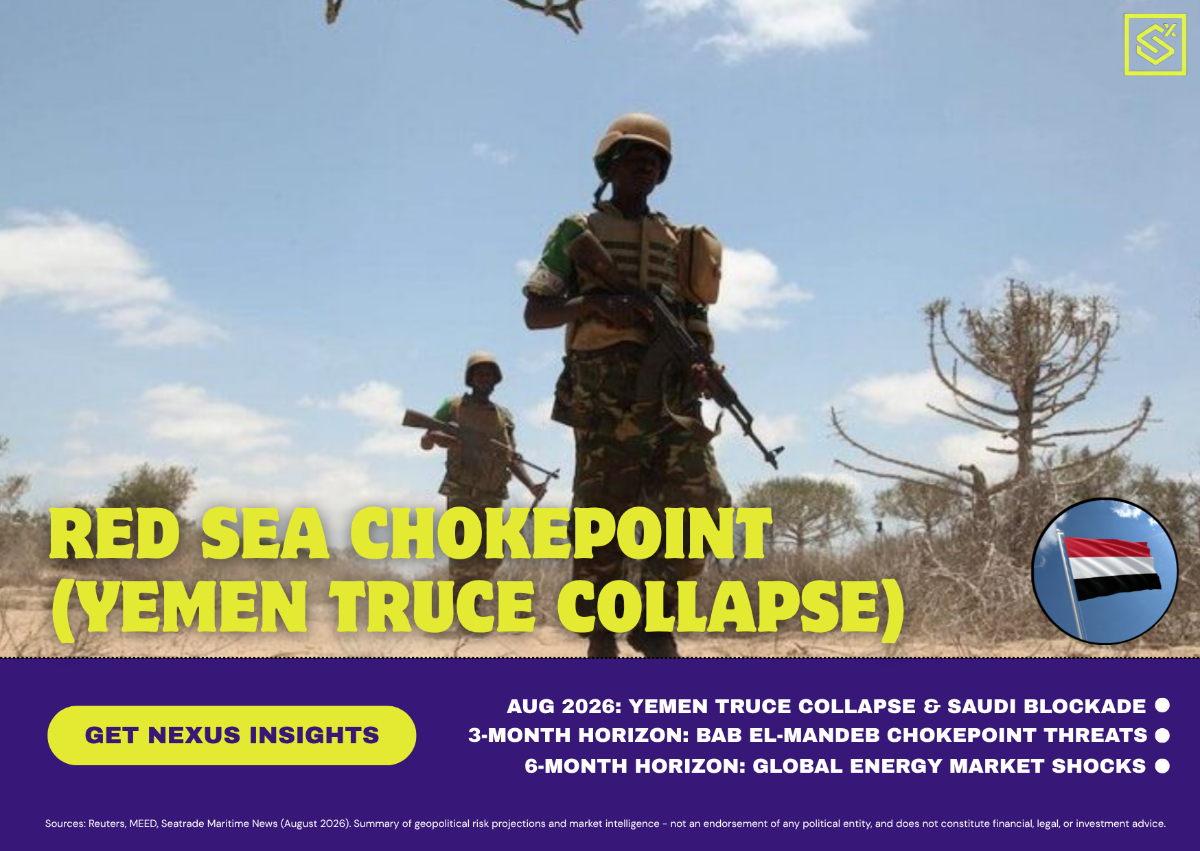
On August 7, 2026, quantitative risk models registered a major escalation signal in the southern Arabian Peninsula. Data from SaPEX NEXUS's Geo Risk AI model indicates an 80 percent probability that the UN-brokered truce established in 2022 is on the brink of complete structural collapse. The primary trigger for this sharp operational update is a recent Houthi claim of a direct attack against a Yemeni military camp. This aggressive military action marks a major departure from the fragile cessation of hostilities that had persisted since formal negotiations took place, shifting the platform classification of the event to high severity with a prediction type of open war.
The renewed offensive conduct by the Iran-backed Houthi movement directly targets the internationally recognized Yemeni Government and Saudi-backed forces operating across strategic territories in Yemen. For macro traders and commodity analysts, this tactical development represents far more than a localized military friction point. It signals a widespread shift in geopolitical risk factors across crucial trade corridors. When predictive probability trackers like SaPEX NEXUS's Geo Risk AI model issue an 80 percent probability score for open military conflict, it highlights that diplomatic mechanisms are failing to prevent a transition back toward widespread kinetic operations.
Understanding the financial market implications requires examining the structural context of the underlying truce. The UN-brokered truce originally agreed upon in 2022 provided an essential buffer period, reducing cross-border attacks and offering temporary stability to regional energy routes. However, fundamental strategic disagreements between the primary actors remained unresolved during this window. With military camps now suffering direct attacks, the likelihood of a broader regional engagement rises significantly, directly influencing sovereign risk premiums, energy pricing models, and international maritime route planning.
Strategic Motives Driving the Primary Actors
Analyzing the underlying motivations of each actor clarifies why a return to full-scale conflict appears increasingly likely. According to analysis conducted via the SaPEX NEXUS Prediction Arena tracker, the Houthi movement is driven primarily by an ambition to consolidate domestic political power, expand its territorial footprint, and systematically weaken rival political factions across the country. By targeting government positions and military infrastructure, the group aims to maximize its leverage prior to any future diplomatic negotiations or simply capture strategic regional positions through physical force.
Beyond localized power dynamics, external alignment plays a central role in sustaining the conflict. Iran continues to leverage its alliance with the Houthi movement to project regional influence and maintain strategic pressure on Saudi Arabia. Conversely, Saudi Arabia views the stabilization of Yemen as an absolute national security requirement. The key operational goals for Saudi Arabia involve preventing Houthi dominance along its southern flank, protecting domestic economic infrastructure from potential strike hazards, and maintaining border security across its perimeter.
At the same time, the internationally recognized Yemeni Government faces severe pressure as it attempts to protect strategic territories and prevent the erosion of its administrative governance. As military engagements target government defense installations, the capacity of government forces to hold territory depends heavily on external support from Saudi-backed coalitions. This complex web of conflicting priorities creates a environment where localized military actions rapidly escalate into wider proxy conflicts with direct consequences for international trade.
Timeline and Severity of the Impending Escalation
The operational timeline generated by SaPEX NEXUS platform tracking indicates that while tactical friction is already active, a broader transition into full-scale conflict is anticipated within a three to six month window. This time frame reflects the operational realities of modern warfare. Armies and non-state armed groups rarely move instantly from truce positions to comprehensive theater-wide offensives without a distinct period of logistics assembly, troop positioning, and strategic preparation.
During this three to six month window, financial markets typically reflect heightened risk premiums as trading desks price in various military escalation scenarios. The high severity rating assigned by platform modeling accounts for both the human toll of renewed fighting and the macro-level economic disruptions that accompany prolonged combat operations in energy-sensitive regions. In general terms, military escalations involving state and non-state actors in close proximity to primary trade corridors generate systematic volatility across energy derivatives, freight rates, and broader financial markets.
Tracking this escalation timeline requires focusing on concrete structural developments rather than short-term rhetoric. Data feeds monitored within the SaPEX NEXUS platform prioritize physical indicators such as troop repositioning, artillery deployments near territorial boundaries, and operational status shifts around critical transport infrastructure. When an open war classification coincides with an 80 percent probability score, portfolio managers must consider defensive positioning before full-scale military actions begin affecting global supply chains.
Vulnerabilities Across Red Sea Shipping Lanes
The geographic positioning of the conflict creates severe hazards for global maritime logistics. The southern coast of Yemen borders the Bab al-Mandab strait, a narrow maritime chokepoint that connects the Red Sea to the Gulf of Aden and the broader Indian Ocean. A substantial portion of global seaborne crude oil, refined petroleum products, and liquefied natural gas passes through this narrow waterway every day, making it one of the most critical maritime transit corridors in global commerce.
Kinetic operations and territorial clashes adjacent to the Red Sea create immediate hazards for commercial shipping lines. When naval security deteriorates, vessel operators often face heightened risks from anti-ship weaponry, aerial drones, and sea mines. To protect crew members and high-value cargo, shipping lines may choose to avoid the Red Sea entirely, rerouting vessels around the Cape of Good Hope at the southern tip of Africa. This rerouting adds thousands of nautical miles to standard voyages, significantly extending transit schedules and reducing effective global shipping capacity.
Insurance markets react almost immediately to security disruptions in vital shipping lanes. Per data recorded in SaPEX NEXUS threat assessments, market impact manifests through a rapid increase in war risk insurance premiums for vessels operating in the Red Sea and adjacent waters. Elevated war risk premiums significantly increase the operational cost of transporting energy commodities, creating cost-push inflationary pressures across energy supply chains even before any physical disruption to crude oil production takes place.
Market Impact and Implications for Energy Traders
The fundamental channel through which the Yemeni conflict impacts financial markets is global energy pricing. Heightened instability surrounding the Bab al-Mandab strait creates immediate upward pressure on international benchmark crude oil prices. Even when physical oil fields in surrounding countries remain unimpacted by active combat, energy traders routinely build a geopolitical risk premium into oil futures to account for potential transport delays and supply disruptions.
Institutional investors and energy desks utilize quantitative indicators, such as the 80 percent probability metric published by SaPEX NEXUS systems, to recalibrate systemic risk exposure and hedging strategies. A full-scale escalation involving regional powers raises concerns over broader security threats to nearby energy processing facilities and export hubs. Consequently, option volatility curves and prompt futures contracts often experience sharp upward movement as market participants demand protection against sudden supply shocks.
Successfully navigating these volatile market conditions requires understanding the path from geopolitical friction to market impact. Traders following these developments must balance immediate risk premiums against underlying physical market fundamentals such as commercial inventory levels and overall demand trends. By leveraging concrete probability scores, clear execution timelines, and actor analysis provided by platform intelligence systems, traders can systematically evaluate risk exposure during periods of heightened geopolitical instability.